
3 Strength Exercises for Women Over 60 Starting From Scratch
Starting strength training after 60 can feel overwhelming, especially if you haven’t exercised in years. These three simple strength exercises can give you a practical place to begin without making the process more complicated than it needs to be.
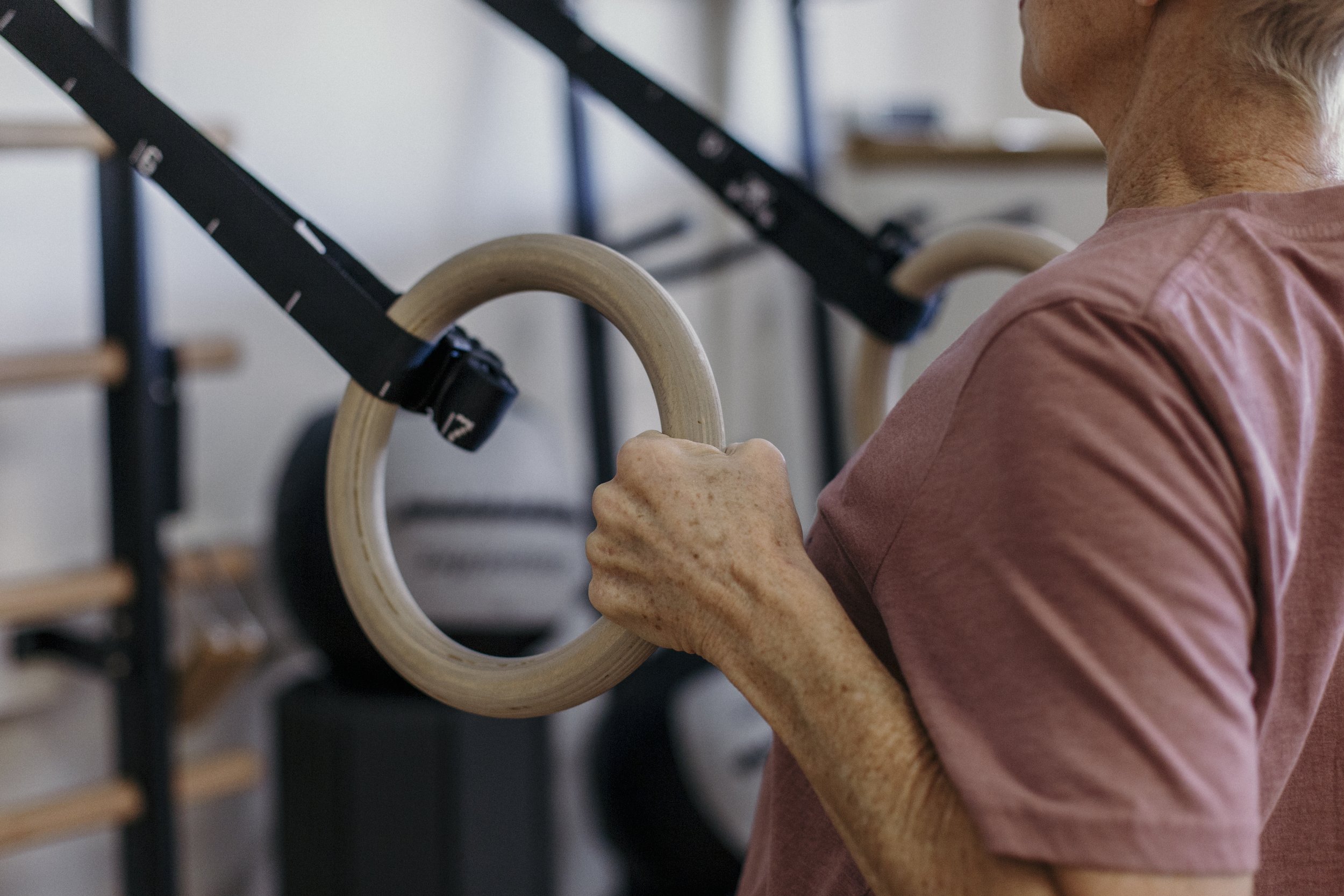
There are plenty of gyms and personal trainers in Mt. Lebanon, Upper St. Clair, and Peters Township. So you would think getting started with strength training after 60 would be easy.
But after meeting and speaking with dozens of women over 60 from these communities over the past decade, I know that is often not the case.
Many women over 60 are not looking for another trendy fitness class that moves too fast, feels impersonal, or is hard on their joints. They are trying to figure out where to begin, which exercises are appropriate, and how to get stronger without feeling overwhelmed or doing something that feels too advanced.
What usually matters most is having a program that is built around her body, her current strength and flexibility, her exercise history, and what she wants to be able to do in everyday life.
While I cannot create a personalized strength plan for you through an article, I can share three foundational strength exercises that are often a great starting point for women over 60 who are starting from scratch.
Strength Exercise #1: The Elevated Squat
After 60, you need to be thoughtful about how you squat.
Many gyms, personal trainers, and YouTube workouts don't take into consideration the stiffness, weakness, or loss of strength that may have built up over the years. Starting with a deep squat or a difficult squat variation can simply be too much for someone who hasn't exercised in a long time.
That said, doing the right squat for your body can do wonders after 60.
Squats strengthen many of the muscles in your legs and hips while also putting healthy resistance through the lower body. Stronger legs can make a noticeable difference in everyday life.
Your legs are responsible for getting you from place to place. They help you get out of a chair, climb stairs, get up from the floor, pick something up, carry groceries, travel, garden, and do countless other things throughout the day.
When your legs get stronger, many of those activities can start to feel easier.
For many women over 60 who are starting from scratch, the Elevated Squat is a very good place to begin because the chair gives you a clear target and keeps you from having to squat lower than your body is ready for.
How to do the Elevated Squat
Step 1: Place a sturdy chair behind you. Put the chair against a wall so it cannot slide backward.
Step 2: Stand in front of the chair and slowly push your hips back as you lower yourself toward it.
Step 3: As soon as your hips touch the chair, stand back up.
Step 4: Repeat 5 to 20 times.
If you haven't exercised in many years, starting with just 5 repetitions may be plenty. There is no prize for doing 20 on the first day.
Start small and gradually build up as the exercise becomes easier.
A long-term goal could be working toward 30 slow, controlled repetitions with good form. Once that becomes easy, there are many ways to progress the squat and make it more challenging without jumping too far ahead too quickly.
Strength Exercise #2: The Wall Plank
The plank is a simple exercise that can strengthen your core and shoulders at the same time.
That matters after 60 because your core helps support your body during everyday movement, while stronger shoulders can make activities like carrying bags, reaching, lifting, and maintaining good posture easier.
The mistake I often see in gyms and online workouts is starting people on the floor.
For someone who is starting from scratch, a floor plank may be much more difficult than necessary. It can also put you in a position that feels uncomfortable for your neck, shoulders, or back before you have built enough strength to handle it well.
A Wall Plank gives you many of the same basic benefits while allowing you to start in a much more manageable position.
Floor planks can be a great future progression for some women. They just don't have to be the starting point.
How to do the Wall Plank
Step 1: Place your forearms against a sturdy wall. Your elbows should be roughly in front of your shoulders with your forearms resting comfortably on the wall.
Step 2: Take a small step away from the wall.
Step 3: Keep your body in a straight line.
One of the most common things I see when someone is first learning this exercise is pushing the hips backward. Try to avoid that. Think about creating one straight line from your ankles through your hips and up toward your shoulders.
Step 4: Hold the position for 10 to 30 seconds.
Just like with the Elevated Squat, start small.
If 10 seconds feels challenging, start there. Your body does not need to be pushed as hard as possible when you're beginning again. It needs to be gradually challenged as you become stronger.
Over time, you can work toward longer holds. Once you can comfortably hold the Wall Plank for an extended period with good form, there are many more challenging plank variations that can be introduced.
Strength Exercise #3: The Floor Heel Lift
After 60, the feet and calves are easy to overlook.
Most people think about strengthening their legs, arms, or core. But your feet and calves are involved almost every time you stand, walk, climb stairs, or move across uneven ground.
That makes them especially important for everyday life.
Whether you're walking through your neighborhood, climbing a set of steps, traveling, or spending time at one of the local parks in Mt. Lebanon, Peters Township, or Upper St. Clair, your feet and calves are working underneath you the entire time.
I like to think of them like the tires on your vehicle.
Your tires are the part of the vehicle that actually meets the road. You could have a great engine, but the tires still play an important role in how the vehicle handles the ground underneath it.
Your feet and calves are similar. They are your connection to the ground every time you take a step.
The Floor Heel Lift is a simple way to begin strengthening them.
How to do the Floor Heel Lift
Step 1: Stand about one foot away from a sturdy wall.
Step 2: Place your hands on the wall for support.
Step 3: Slowly lift your heels as high off the ground as you comfortably can. Then slowly lower them back down.
Step 4: Repeat 5 to 20 times.
If you haven't exercised in a long time, start with fewer repetitions and see how your body responds.
You can gradually add more as you get stronger.
Once you can perform around 30 slow, controlled repetitions with ease, it may be time to progress to a more challenging variation so your body continues to have a reason to get stronger.
A Better Place to Start
These three exercises can give you a helpful starting point, but they are still only a starting point.
The best strength program after 60 should take into consideration your current strength, flexibility, exercise history, and what you want to be able to do in everyday life. The right exercises should also change as you get stronger.
At A50 Personal Training, we help women over 50 in the South Hills build strength and flexibility with personal guidance and exercises that are adjusted to where they are starting.
If you live in Mt. Lebanon, Upper St. Clair, Peters Township, or another nearby South Hills community and you are not sure where to begin, you can schedule one free week of personal training at A50 Personal Training. It gives you a chance to experience our approach and see whether it feels like the right fit for you.
And if you are planning to exercise at home or are wondering what equipment is actually worth having, you may also find our article The Best Exercise Equipment for Women Over 60 helpful.
ABOUT THE AUTHOR
Jason Zawodniak is the Co-founder of A50 Personal Training, the first personal training studio in the South Hills built exclusively to serve women over 50. With nearly two decades of experience in the fitness industry, Jason noticed early in his career that women over 50 were consistently underserved — showing up to gyms where they felt out of place, unsure of what to do, and afraid of getting hurt. After hearing those same stories from his own clients year after year, he made a decision: in 2017, he opened A50 to create the program he knew this demographic deserved. Today, Jason specializes in helping women over 50 build the strength and flexibility they need to stay active, prevent injury, and keep up with the people and activities they love most.