
Do you really need to lift heavy weights to get stronger after 60? Learn four important rules that can help you build strength, choose the right weights, and avoid getting hurt.
Many of our clients listen to podcasts, watch YouTube videos, and follow advice from fitness experts. And one message they're hearing more often is that women over 60 need to lift very heavy weights if they want to get the best results.
There's some truth to this advice. Strength training is one of the most important things you can do after 60. It helps strengthen your muscles and bones, making everyday activities like climbing stairs, carrying groceries, gardening, and keeping up with your grandchildren easier.
But there's also some confusion when it comes to how heavy your weights should actually be, especially if you haven't exercised in years.
Telling a woman in her 60s or 70s that she needs to lift very heavy weights without explaining how to get there can be dangerous. Starting with weights that are too heavy for your current strength and ability can lead to poor form and increase your chances of getting injured.
Here are four rules we follow at A50 Personal Training that can help you build strength after 60 while reducing your risk of injury.
Rule #1: Start With Your Own Body Weight
One of the biggest mistakes people make when starting strength training is assuming they need dumbbells, kettlebells, or other weights right away.
But depending on your current strength, you may not need any additional weight when you're first getting started.
For example, think about getting up from a chair without using your hands. If that's difficult for you, simply practicing that exercise can help strengthen your legs. You're already lifting the weight of your own body, even though you're not holding a dumbbell.
Just this week, one of our new personal training clients was confused when we started her with exercises using only her body weight. We explained that before adding heavier weights, we first wanted to make sure she could perform the exercises correctly using her own body weight.
If you're struggling to perform an exercise correctly without any added weight, adding a heavy dumbbell or kettlebell is only going to make it more difficult. This can lead to poor form and increase your chance of getting injured.
Now, this doesn't mean you should avoid lifting heavier weights. In fact, gradually increasing the weight you lift is an important part of continuing to get stronger. But you need to build the strength and learn the exercise before adding more weight.
The goal is to start with exercises that are appropriate for your body today and gradually make them more challenging as you improve. For some women, that means starting with their own body weight. For others, lighter dumbbells or kettlebells may be appropriate.
What's important is that you start at the right level for you.
Rule #2: Start With 10 to 15 Repetitions
Another recommendation I've heard from fitness experts is that women over 60 should lift weights heavy enough that they can only perform about five repetitions, or five times, before needing to stop.
While this can be good advice for someone who has been strength training for years, it's rarely where I would recommend someone begin if they're new to exercise.
At A50, we often start new clients with 10 to 15 repetitions of each strength exercise. There are two important reasons for this.
First, when you're learning a new exercise, you need time to practice it. Performing an exercise 10 to 15 times gives you more opportunities to learn the proper technique and become comfortable with what you're doing.
Second, when you're performing 10 to 15 repetitions instead of just five, you'll generally use a lighter weight. This can help reduce unnecessary stress on your joints while you're still learning the exercise.
Think about the difference between lifting a weight that's so heavy you can barely lift it five times and using a lighter weight you can comfortably control for 10 to 15 repetitions.
Both can help build strength, but when you're new to exercise, the lighter weight often gives you a better opportunity to learn the exercise correctly without putting too much strain on your body.
As you become stronger and more experienced, lifting heavier weights for fewer repetitions may be appropriate. But there's no need to rush that process, especially if you're just getting started.
Remember, your goal isn't simply to lift the heaviest weight possible. It's to build strength that helps you stay active and continue doing the things you enjoy.
Rule #3: Learn Proper Form First
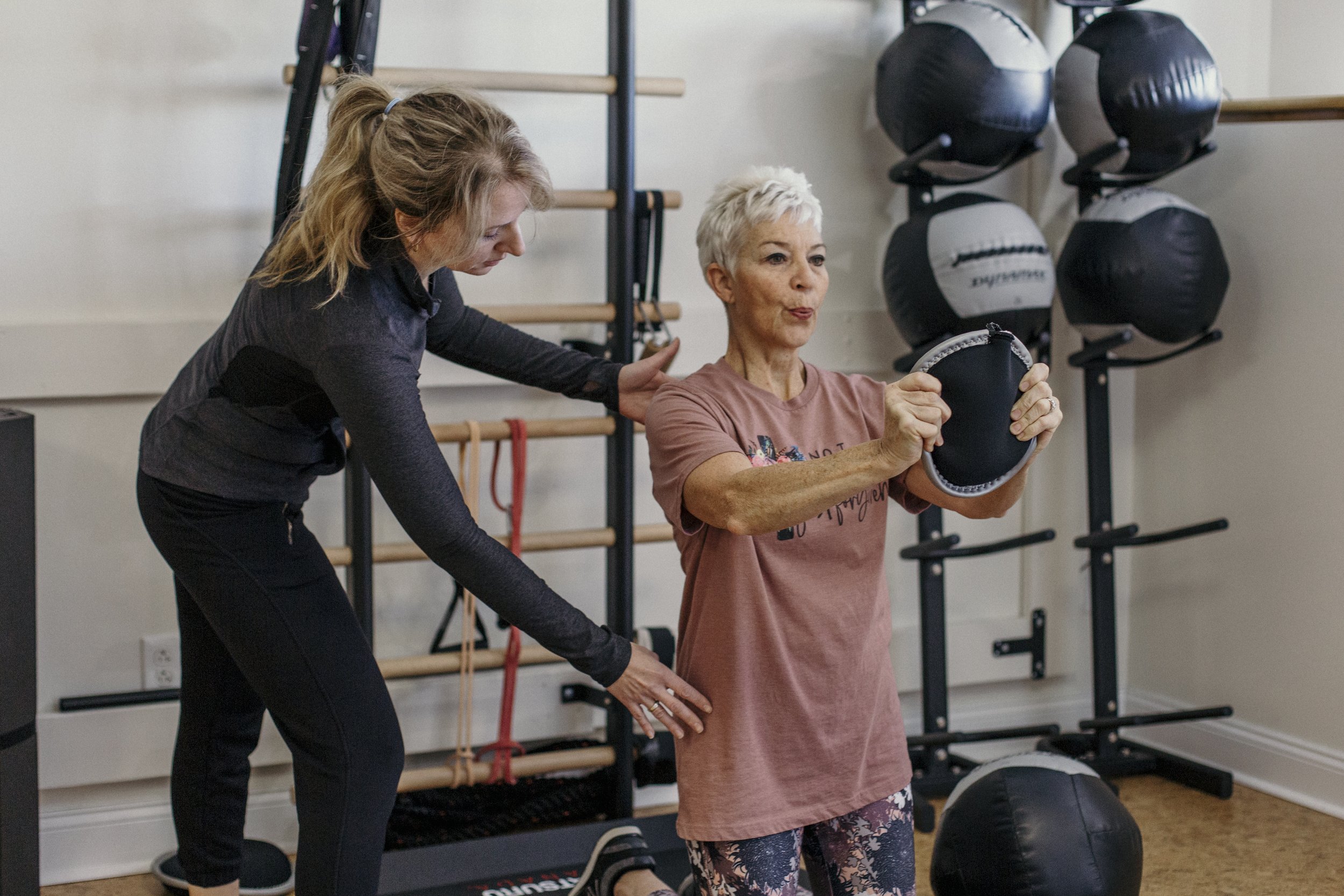
When a new client starts personal training with us, one of the first things we explain is that their initial goal is to learn how to perform each exercise correctly.
I know, that probably doesn't sound very exciting. Most women come to us because they want to get stronger, feel less stiff, and start noticing improvements in their everyday lives.
But learning proper form is one of the most important parts of getting those results.
Think about it this way. If you're lifting a weight that's too heavy, you may find yourself twisting your body, rushing through the exercise, or using other muscles to help finish it. You may be completing the exercise, but you're not necessarily doing it correctly.
Good form means you're performing the exercise in a controlled way, using the muscles you're trying to strengthen without putting unnecessary stress on your joints.
You should feel your muscles working, and they may become tired as you continue. But if you're feeling pain in a joint, that's a sign to stop and adjust the exercise rather than push through it.
We've found that most of our clients learn to perform the majority of their exercises correctly within their first few months. And something interesting often happens around the three-month mark.
Many of our clients are surprised by how much stronger they're getting.
We're not surprised. They've spent the first few months learning how to perform their exercises correctly, and now they're beginning to enjoy the results of that effort.
As their form improves, they're able to perform exercises with better control and gradually use heavier weights when appropriate.
That's why we place so much importance on proper form. It's not something you should rush through so you can start lifting heavier weights. It's an important part of building the strength you want.
Rule #4: Focus on Quality, Not Quantity
Another common mistake is assuming that more exercises or more repetitions will automatically lead to better results.
For example, is performing 30 repetitions of an exercise better than performing 15? Or is a workout with 12 different exercises better than one with just four?
Not necessarily.
I'd much rather see someone perform 15 repetitions with excellent form than 30 repetitions with poor form. And I'd rather see someone perform four exercises correctly than rush through 12 exercises they haven't learned how to do.
The number of exercises you complete isn't nearly as important as how well you perform them and whether they're appropriate for your body.
Unfortunately, many fitness classes and online workout programs promote the idea that more is always better. More exercises, more repetitions, heavier weights, and longer workouts.
While these programs may work well for some people, they can be a poor fit for a woman in her 60s or 70s who's just starting to exercise again.
When you're trying to complete too many exercises, especially ones you're unfamiliar with, it's easy to rush through them or continue even when your form is getting worse. That's when your chances of getting hurt can increase.
Instead, focus on learning a few important strength exercises and performing them correctly. Once you're comfortable with those exercises, you can begin making them more challenging or adding others that will help you reach your goals.
You don't need to perform dozens of different exercises to get stronger. You need exercises that are appropriate for you, performed correctly and consistently over time.
Quality should always come before quantity.
How to Know Your Next Step
One question people often ask us is, "What's my next step?"
Reading an article like this can help you better understand strength training after 60, but knowing what to do next isn't always easy. And the right next step will depend on where you're starting.
If you're just beginning to consider strength training and want to learn more before getting started, that may be the best place to begin. Our article, Strength, Cardio, or Flexibility: What Should Women Over 60 Focus On First?, can help you better understand which types of exercise deserve your attention.
On the other hand, if you're ready to begin but want someone to help you choose the right exercises, learn proper form, and gradually build strength without doing too much too soon, you can apply for a free week of personal training.
At A50 Personal Training, we specialize in helping women over 50 get stronger and more flexible so they can stay active, avoid injuries, and keep up with family. We have one studio, located in the South Hills on the border of Mt. Lebanon and Upper St. Clair.
Whatever your next step may be, the important thing is to get started in a way that makes sense for you. You don't need to lift extremely heavy weights or perform complicated workouts to begin getting stronger.
Start where you are today, learn to do the exercises correctly, and gradually build from there.
ABOUT THE AUTHOR
Jason Zawodniak is the Co-founder of A50 Personal Training, the first personal training studio in the South Hills built exclusively to serve women over 50. With nearly two decades of experience in the fitness industry, Jason noticed early in his career that women over 50 were consistently underserved — showing up to gyms where they felt out of place, unsure of what to do, and afraid of getting hurt. After hearing those same stories from his own clients year after year, he made a decision: in 2017, he opened A50 to create the program he knew this demographic deserved. Today, Jason specializes in helping women over 50 build the strength and flexibility they need to stay active, prevent injury, and keep up with the people and activities they love most.