
Why You Feel So Stiff After Sitting (And What To Do About It)
Many women over 50 notice they feel stiff getting up from the couch, out of the car, or after sitting for a while. The good news is that stiffness isn't something you simply have to accept. In this article, we'll look at some of the most common reasons it happens and what you can do about it.
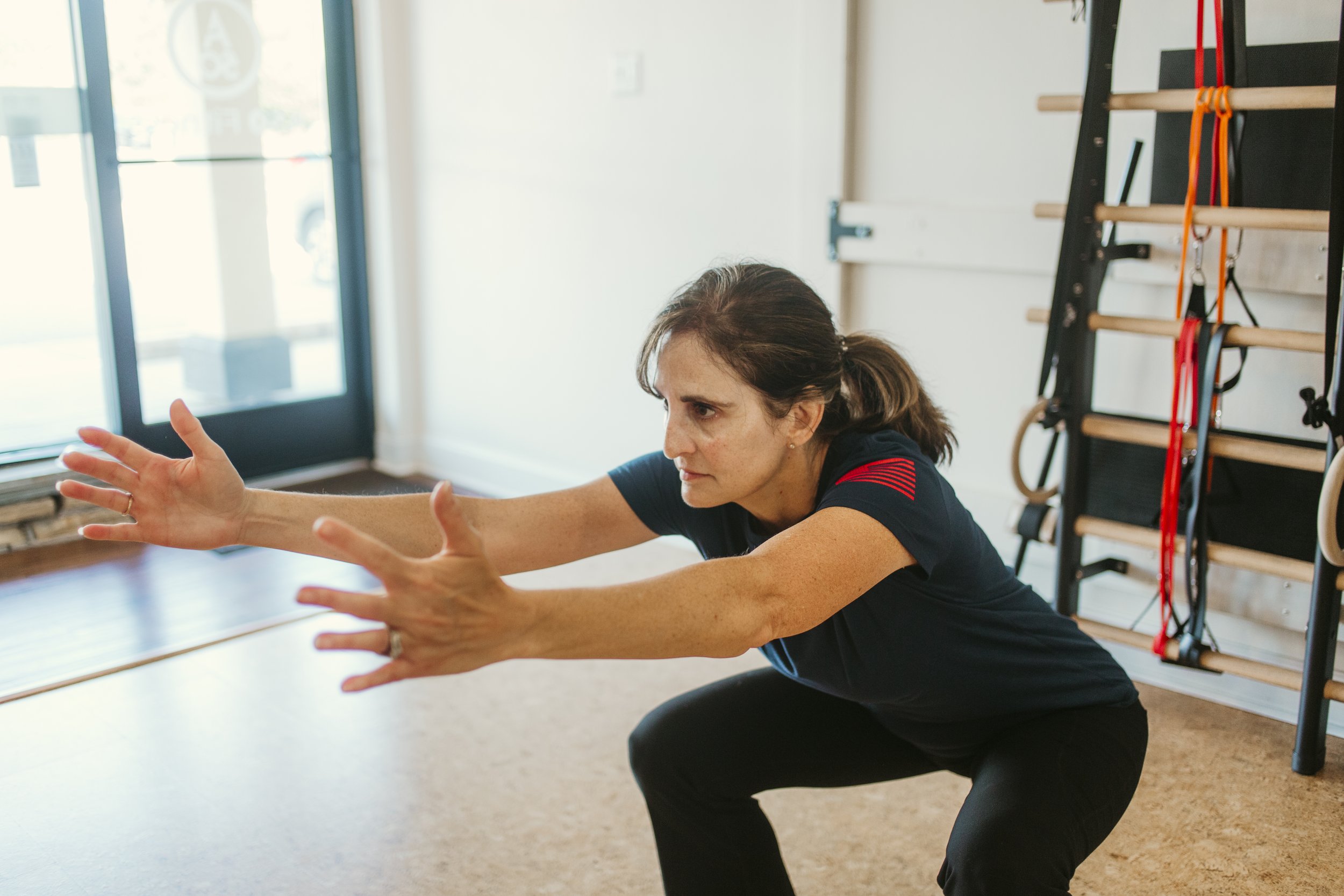
If you've noticed it takes a few extra steps to "loosen up" after sitting for a while, you're not alone.
Many women over 50 notice stiffness when they get off the couch, step out of the car, or stand up after sitting through dinner with family and friends.
What bothers them most isn't the stiffness itself.
It's what the stiffness represents.
I've heard women say things like, "I feel older than I should when I stand up," or "It's like my body gets stuck if I sit too long." Those moments can be frustrating because they make you feel less capable than you used to.
The good news is that stiffness after sitting is extremely common. More importantly, it's often something you can improve. While some changes in our bodies are a normal part of getting older, feeling stiff every time you stand up doesn't automatically mean you have to accept it as your new normal.
In many cases, stiffness is your body's way of telling you it needs more movement, more strength, or more flexibility. Understanding why it happens is the first step toward doing something about it.
In this article, we'll look at some of the most common reasons stiffness develops and what you can do to improve it.
Reason #1: Poor Sitting Posture
Many women spend several hours each day sitting.
Whether it's watching TV, reading, driving, working at a computer, or catching up with friends over lunch, sitting is simply part of modern life.
The problem isn't sitting itself.
The problem is that most people sit with poor posture.
Over time, the head drifts forward, the shoulders round, and the upper and lower back settle into a slouched position. When you stay in these positions for long periods, your muscles and joints begin to adapt.
Then when it's time to stand up, your body has to quickly move from that rounded position back to an upright one.
That's one reason many women feel stiff during those first few steps after getting up.
A simple place to start is paying more attention to your posture while sitting throughout the day.
Try to:
• Sit tall through your upper body
• Keep your shoulders relaxed rather than rounded forward
• Place both feet flat on the floor
• Avoid sinking into a slouched position for long periods
• Change positions and move around periodically
You don't need perfect posture.
You simply want to avoid spending hours at a time in poor posture.
Reason #2: Your Hips Have Lost Flexibility
Many women assume their lower back is the problem because that's where they feel the stiffness.
Often, the hips are the bigger issue.
After decades of sitting, it's common to lose flexibility in the hips. When the hips become stiff, simple movements such as standing up, walking, climbing stairs, or bending down become more difficult.
Getting out of a chair doesn't create the stiffness.
It simply exposes a problem that was already there.
In other words, your hips were already stiff. Standing up just reminds you of it.
This is one reason many women feel stiff not only when they first stand up, but throughout the day as well.
One of the simplest ways to improve hip flexibility is through regular stretching.
Single Knee To Chest Stretch
This is one of my favorite beginner-friendly stretches because it's simple, comfortable, and works well for many women over 50.
How to perform the stretch:
Lie on your back with both legs straight.
Pull one knee toward your chest as far as comfortably possible.
Hold the stretch for 1–2 minutes.
Keep the opposite leg straight on the floor.
Repeat on the other side.
Tip: If holding your knee feels uncomfortable or straining, place a towel behind your knee and use the towel to gently help pull your knee closer to your chest.
Like most flexibility exercises, consistency matters more than intensity.
A few minutes several times each week can make a meaningful difference over time.
Reason #3: Your Hips May Be Weak, Too
Don't confuse this with the previous section.
Reason #2 was about tight hips.
Reason #3 is about weak hips.
These are two very different problems.
When I say "hips" in this section, I'm mainly talking about the glutes (i.e. the butt muscles). These muscles play a major role in helping you stand up, climb stairs, get off the floor, and move comfortably throughout the day.
They are some of the largest muscles in your body and play a major role in how easily you move.
The glutes help you:
• Stand up from a chair
• Climb stairs
• Get out of a car
• Get off the floor
• Walk up hills
• Maintain balance
If these muscles become weak, everyday tasks begin to feel harder.
Many women spend years stretching but never address the strength side of the equation.
That's why flexibility alone isn't always enough.
If getting out of a low car, sofa, or off the floor has become more difficult, you probably don't just have a flexibility issue.
You likely have a strength issue as well.
And don't believe the idea that getting weaker is simply part of getting older.
While some muscle loss naturally occurs with age, strength can absolutely be improved after 50.
One of the best beginner-friendly exercises for strengthening the hips is the bridge.
Bridge Exercise
How to perform the exercise:
Lie on your back with your knees bent and feet flat on the floor.
Position your feet approximately 6–8 inches in front of your hips.
Press your feet firmly into the floor.
Lift your hips toward the ceiling as high as you comfortably can.
Hold for 5 seconds.
Lower back down and repeat.
Perform 10 repetitions.
Important: Do not arch your lower back. Focus on lifting your hips using the glutes. If you feel the exercise mostly in your lower back, you're probably lifting too high.
The bridge is a simple but effective exercise that can help rebuild strength in the hips and make everyday movements feel easier.
The good news is that many women improve how they feel after sitting by addressing all three of these areas. Better posture, improved flexibility, and stronger hips work together to help you move more comfortably throughout the day.
A Better Next Step
If you're feeling stiff every time you stand up, it's easy to assume you just need to stretch more.
But as you've learned in this article, stiffness is often the result of several factors working together. Poor posture, tight hips, and weak hips can all contribute to how you feel when you get up from a chair, out of a car, or off the couch.
The challenge is figuring out which areas deserve the most attention.
At A50 Personal Training, we help South Hills women over 50 get stronger and more flexible so they can stay active, avoid injury, and keep up with family.
Our studio is built specifically for women over 50 who want personalized guidance in a supportive environment without the pressure, confusion, or intimidation of a traditional gym.
If you'd like to learn more about choosing the right trainer and program for your goals, you may also enjoy reading:
How to Find the Right Personal Trainer After 50
And if you'd like help creating a plan that's tailored to your body, goals, and current fitness level, you can apply for a free 1-week personal training trial and see if A50 is a good fit for you.
ABOUT THE AUTHOR
Jason Zawodniak is the Co-founder of A50 Personal Training, the first personal training studio in the South Hills built exclusively to serve women over 50. With nearly two decades of experience in the fitness industry, Jason noticed early in his career that women over 50 were consistently underserved — showing up to gyms where they felt out of place, unsure of what to do, and afraid of getting hurt. After hearing those same stories from his own clients year after year, he made a decision: in 2017, he opened A50 to create the program he knew this demographic deserved. Today, Jason specializes in helping women over 50 build the strength and flexibility they need to stay active, prevent injury, and keep up with the people and activities they love most.