
Why Walking Alone Isn't Enough for Women Over 60
Walking is one of the best forms of exercise for women over 60, and we encourage it often. The problem is that walking alone doesn't do much to maintain strength, balance, flexibility, or bone health. In this article, we'll explain what walking does well, where it falls short, and what to add to your routine to stay strong, active, and capable for years to come.
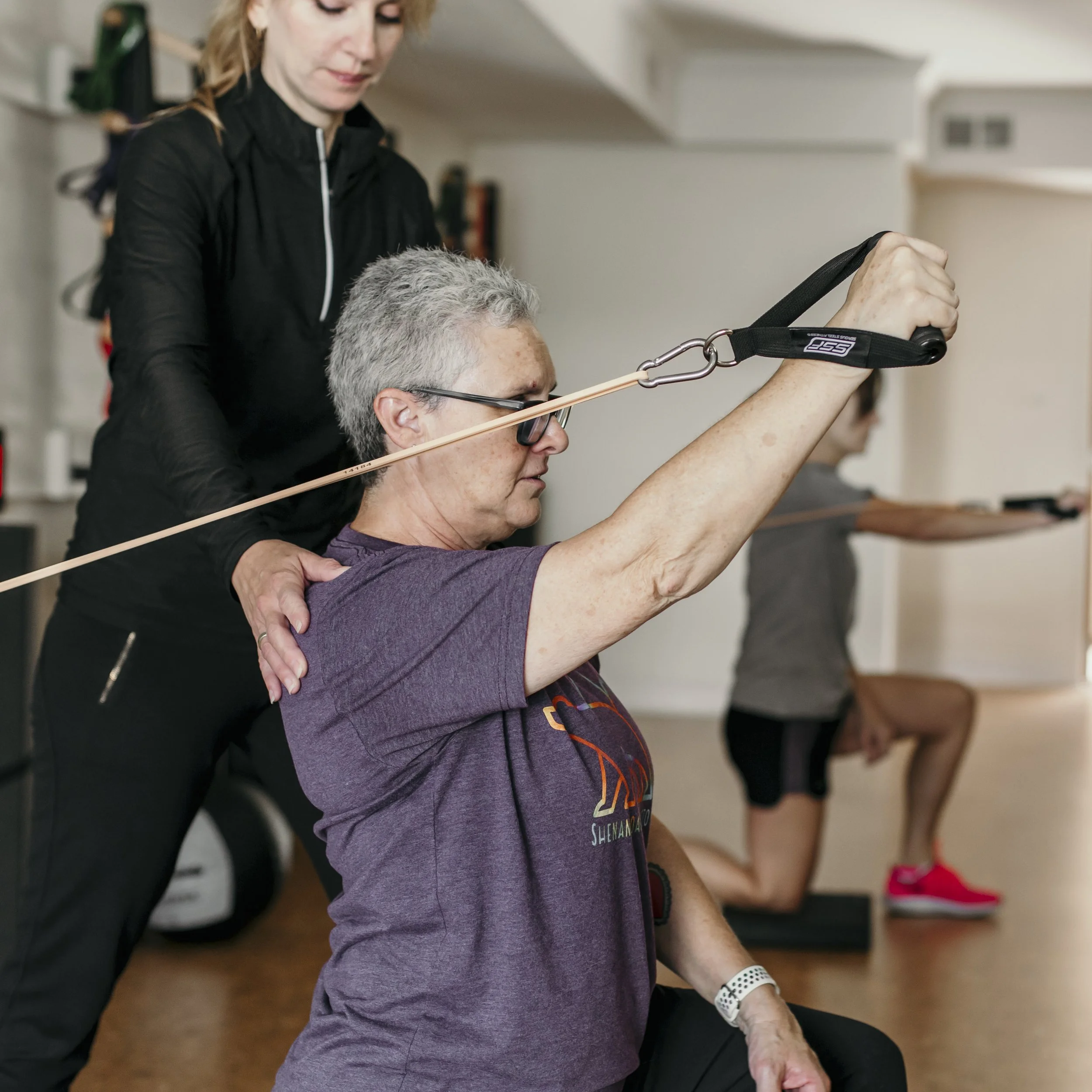
Walking is one of the best forms of exercise for women over 60. It's simple, accessible, low-impact, and doesn't require a gym membership or special equipment. Research has shown that regular walking can improve heart health, help manage weight, boost energy levels, and even improve mood.
Because of these benefits, I often encourage women to walk. If you're already walking several times per week, that's a great habit to continue.
Because walking offers so many benefits, many women wonder if it's enough on its own. Over the years, I've met countless women who walk regularly, yet still feel weak carrying groceries, struggle to get up from the floor, feel unsteady on one leg, or notice that lifting luggage into an overhead compartment has become much harder than it used to be.
That's because walking does a great job improving cardiovascular health, but it falls short in several areas that become increasingly important later in life. For example, walking does very little to maintain upper-body strength, core strength, balance, or posture. While it does use the muscles in your legs, the strength-building effect is relatively small compared to dedicated strength training.
Walking should absolutely remain part of your routine. But if you want to keep your strength, balance, and mobility as the years go by, you'll need a few other pieces of the puzzle as well. Let's look at three types of exercise that can help you continue feeling strong, capable, and active after 60.
1. Resistance Exercises
If there is one type of exercise women over 60 should prioritize, it's resistance training.
You may have also heard it called strength training. Regardless of the name, the goal is the same: challenge your muscles so they become stronger.
This becomes increasingly important because we naturally lose muscle as we get older. Unfortunately, muscle loss doesn't just affect how much weight you can lift in the gym. It affects nearly every part of daily life.
Getting up from a chair.
Carrying groceries.
Climbing stairs.
Lifting luggage.
Getting off the floor.
Even maintaining your balance becomes harder when your muscles become weaker.
The good news is that strength can improve at any age. I've seen women in their 60s, 70s, and beyond become noticeably stronger when they consistently perform resistance exercises.
This is why I often refer to strength training as the foundation of healthy aging. Whether your goal is to travel, hike, golf, keep up with grandchildren, or simply feel more confident moving through daily life, strength makes all of it easier.
Walking is excellent for your heart and overall health, but it does very little to challenge the muscles of your upper body and core. Even the strength benefits for your legs are relatively modest compared to dedicated resistance training.
That's why strength training deserves a permanent place in your routine.
2. Mobility Exercises
The second piece many women are missing is mobility training.
You may have heard of flexibility exercises, and those can certainly be helpful. Flexibility exercises focus primarily on stretching muscles. Mobility exercises are a little different. They help your joints move through a healthy range of motion.
While most women have at least heard about stretching, very few include mobility exercises in their routine.
The way your joints move matters.
When your joints become stiff, everyday activities often become harder than they need to be. Bending down to tie your shoes, reaching into a cabinet, getting in and out of a car, or getting up from the floor can all become more challenging.
One of the easiest ways to determine if you need mobility work is to pay attention to how your body feels throughout the day. Do your hips feel stiff when you bend over? Is it becoming harder to get down to the floor and back up again? Do your shoulders feel tight when reaching overhead?
If so, mobility exercises should be part of your routine.
The three areas I encourage women to focus on most are the shoulders, hips, and ankles. These joints play a major role in how comfortably you move throughout the day. When mobility starts to decrease in these areas, everyday tasks often require more effort than they should.
The good news is that mobility can often improve surprisingly quickly with consistent practice. Many women begin noticing movement feels easier within a few weeks of adding the right exercises to their routine.
3. Balance Exercises
The third piece of the puzzle is balance training.
Most women never think about their balance until they lose it.
The challenge is that balance often declines gradually over time. Because the changes happen so slowly, many people don't notice a problem until they trip, stumble, or experience a fall.
The good news is that balance can be improved, and one of the easiest ways to assess it is with a simple test at home.
Stand near a wall or sturdy surface for safety. Lift one foot a few inches off the ground and see how long you can balance on the other leg.
There is one important rule.
Keep your arms relaxed at your sides.
Many people automatically lift their arms out to the side to help maintain balance. While there's nothing wrong with that in everyday life, it makes the test much easier because your arms act as a counterbalance.
Test both legs.
If you struggle to reach 30 seconds on either side, it's a good sign that balance exercises should become part of your routine. A great long-term goal is to comfortably stand on each leg for 60 seconds without significant wobbling or struggle.
Once you can do that, you can progress to more challenging balance exercises.
Walking is a wonderful form of exercise and one I encourage often. However, if your goal is to get stronger, move more comfortably, and make everyday activities feel easier, walking works best when it's combined with resistance training, mobility exercises, and balance work.
Together, these three forms of exercise help address many of the challenges women begin noticing after 60. They can help you build strength, improve the way your joints move, and develop better balance so you can feel more capable and confident in everyday life.
A better next step
Walking is one of the best things you can do for your health, and hopefully this article helped you understand where it fits into the bigger picture.
The goal isn't to stop walking.
The goal is to build on it.
When resistance training, mobility exercises, and balance work are added alongside regular walks, everyday life often starts to feel easier. Carrying groceries, climbing stairs, getting off the floor, lifting luggage, and keeping up with family all become a little less challenging.
At A50 Personal Training, we help South Hills women over 50 improve their strength, mobility, balance, and overall fitness so they can feel more capable and confident in everyday life.
Our studio is built specifically for women over 50 who want expert guidance, individualized exercises, and a supportive environment without the pressure or intimidation that often comes with traditional gyms.
If you live in the South Hills and would like help finding the safest and most effective exercises for your body, you can apply for a free 1-week personal training trial.
You'll receive personalized coaching, support, and an opportunity to see if A50 is a good fit for you.
You may also enjoy reading:
ABOUT THE AUTHOR
Jason Zawodniak is the Co-founder of A50 Personal Training, the first personal training studio in the South Hills built exclusively to serve women over 50. With nearly two decades of experience in the fitness industry, Jason noticed early in his career that women over 50 were consistently underserved — showing up to gyms where they felt out of place, unsure of what to do, and afraid of getting hurt. After hearing those same stories from his own clients year after year, he made a decision: in 2017, he opened A50 to create the program he knew this demographic deserved. Today, Jason specializes in helping women over 50 build the strength and flexibility they need to stay active, prevent injury, and keep up with the people and activities they love most.